Inclusive environments
| Question | Answer |
|---|---|
| What is Inclusive design? | Inclusive design means ‘making places everyone can use’, as well as removing barriers that ‘create undue effort and separation’. |
| What is Inclusive environment? | RICS states that an ‘inclusive environment recognises and accommodates differences in the way people use the built and natural environment. It facilitates dignified, equal and intuitive use by everyone. It does not physically or socially separate, discriminate or isolate. It readily accommodates and welcomes diverse user needs’. |
| Which standard guide is available for managing inclusive design? | BS 7000-6:2005 Design management systems: Managing Inclusive Design, published by the British Standards Institution, provides guidance on how to apply inclusive design at both organisational and project levels to a wide range of developments and processes. This can also be used to apply the concept of inclusive design throughout the supply chain. BS 8300-2: 2018: Design of an accessible and inclusive built environment – Buildings PAS 6463:2022 Design for the Mind – Neurodiversity and the built environment |
| How can the built environment be made accessible for visually impaired user? | By providing adequate lighting, non-slip floor coverings, tactile paving, visually contrasted numbers, the use of Braille, keeping accessways clear, providing handrails and installing audio alerts for lifts and escalators. |
| What is neurodiversity? | Neurodiversity refers to the diversity of human minds, and the fact that brains and neurocognition vary among all individuals. |
| Examples of neurodiversity. | dyslexia, dyspraxia, Asperger’s, and attention-deficit/hyperactivity disorder (ADHD) |
| Examples of designing with neurodiversity in mind. | Colour contrasts such as a calm paint colour and avoiding black barrier matting at entrance points, and minimising or preventing visual noise. |
| What is Fitwel? | It is a voluntary building certification, similar to the Building Research Establishment Environmental Assessment Method (BREEAM). However, rather than focusing on the environmental aspect of sustainability, it considers how buildings support the well-being and health of occupants and the local community. |
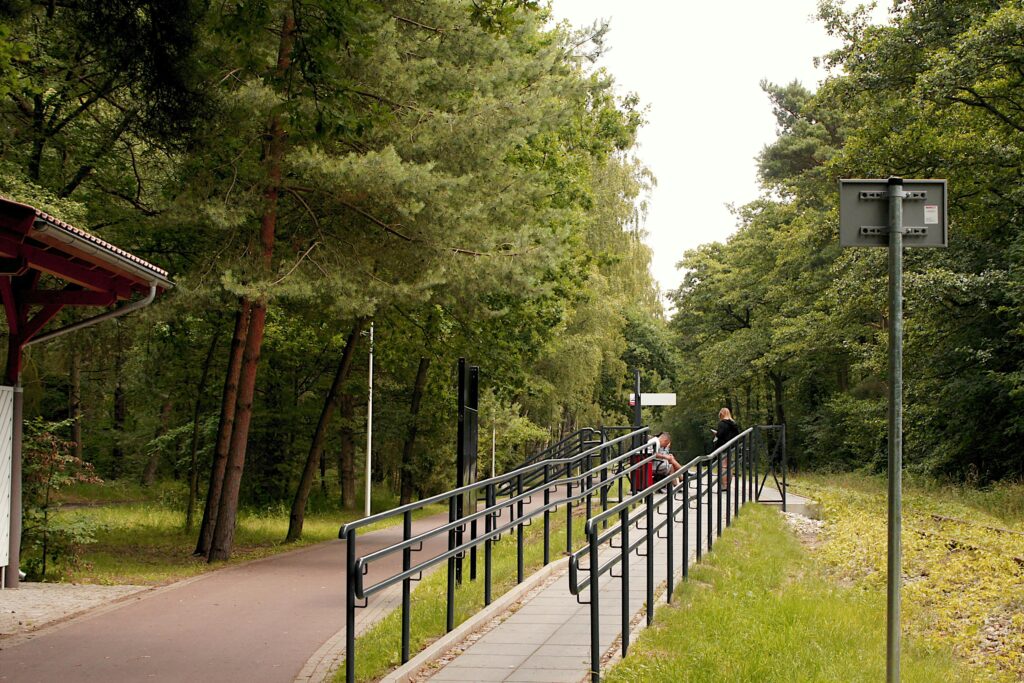
| Examples of inclusive design | Ramps to facilitate access by wheelchair users, visual differentiation through colour schemes, and avoiding the use of stairs. |
| What is the code for Inclusive design in UAE? | United Arab Emirates Universal Design Code. Its purpose is to define how the built environment and transportation systems in the Emirate shall be designed, constructed and managed to enable one to approach, enter, use, egress from and evacuate independently, in an equitable and dignified manner, to the greatest extent possible, in line with the Universal Design concept. |
| What is the Universal Design concept? | Universal Design is the design and composition of an environment so that it can be accessed, understood and used to the greatest extent possible by all people regardless of their age, size, ability or disability. |
| How do you identify any building is constructed by considering the norms of inclusive Environment? | 1. Curb ramps – for people using wheelchairs, parents with strollers, delivery people with carts, and bicyclists 2. Tactile Paving – Tactile paving is a textured surface that is designed to provide a tactile warning of an upcoming change in level, such as a curb or a stairway. Tactile paving helps people with visual impairments navigate their environment safely, and it can also benefit people with mobility impairments. 3. Automatic Doors – Automatic doors are designed to open and close automatically, without the need for physical contact. Automatic doors are especially helpful for people with mobility impairments, but they also benefit people with their hands full, parents with strollers, and many others. 4. Adjustable-Height Work Surfaces – Adjustable-height work surfaces can be raised or lowered to accommodate people of different heights or physical abilities. Adjustable-height work surfaces are especially helpful for people with mobility impairments, but they also benefit people who need to alternate between sitting and standing during the workday. 5. Braille Signage – Braille signage provides tactile information, making it accessible to people with visual impairments. Braille signage can be found in public places such as airports, museums, and hospitals. |
| What are the key principles of inclusive design? | Equitable Use: Any group of users can use the design. Flexibility in Use: A wide range of preferences and abilities is accommodated. Simple, Intuitive Use: Regardless of the user’s prior experience or knowledge, the use of the design is easy to understand. Perceptible Information: Any necessary information is communicated to the user, regardless of environment or user abilities. Tolerance for Error: Any adverse or hazardous consequences of actions is minimized. Low Physical Effort: The design can be used efficiently and comfortably. Size and Space for Approach & Use: Regardless of the user’s body size, posture, or mobility, there is appropriate size and space to approach and use the design. |
| What is the local legislation (UAE) of inclusion? | UAE Federal Law No. 29 of 2006, as amended by Federal Law No. 14 of 2009: Concerning the Rights of People with Disabilities, protects the rights of people of determination and guarantees them the right to live with dignity. In 2017, the UAE launched the National Policy for Empowering Persons with Disabilities under the Ministry of Community Development to enhance social integration |
| What are the features of elevators in support of disabled persons? | wider doors, lower buttons for easy reach, spacious interiors to accommodate wheelchairs, as well as auditory and visual aids for those with sensory impairments. |
| How will you promote an inclusive environment as QS? | Suggest the design team to include Inclusive design features in our project. Give examples. |
| How do you identify whether any building is constructed by considering the norms of Inclusive Environment? | All kinds of people would be able to access the building easily and with minimum effort. Give examples. |
| What is your company’s inclusive policy? | This will be specific to each individual candidate. |
| Could you please give an example of an inclusive environment in your project? | This will be specific to each individual candidate. |